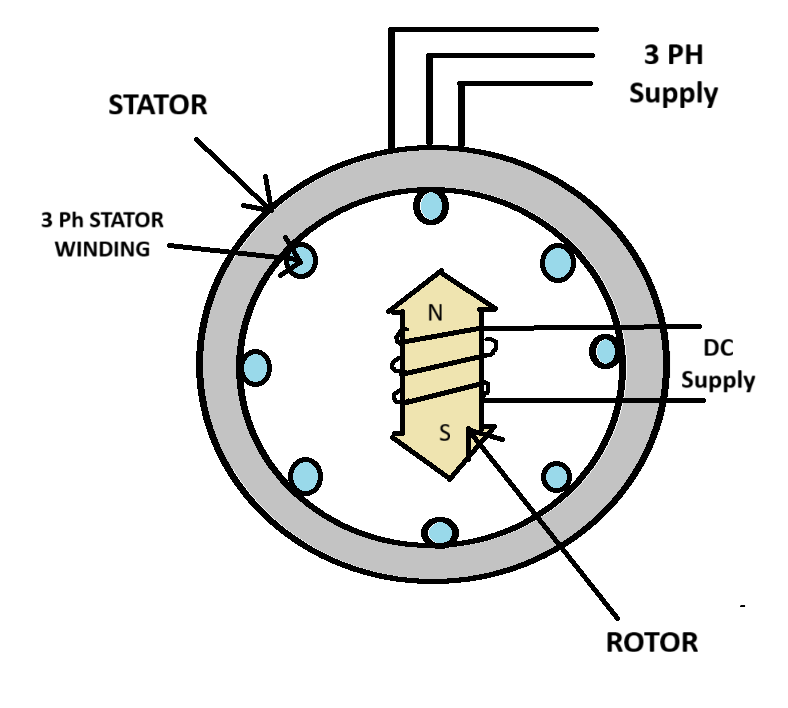
Alternator...
INTRODUCTION :
An Alternator is an electrical machine that converts mechanical energy into electrical energy in the form of alternating current (AC). It works on the principle of electromagnetic induction, discovered by Michael Faraday, so it is also called an AC generator or synchronous Generator. An alternator works by using a set of rotating coils, called the rotor. The rotation of the rotor creates a magnetic field which, in turn, induces an electrical current in a set of stationary coils, called the stator. The stator then converts this electrical current into usable power that can be output to the load. There are different types of alternators based on applications and design. The Marine type alternator, Automotive type alternator, Diesel-electric locomotive types alternator, Brushless type alternator, and Radio alternators are the types of alternators based on the applications. Based on the design, there are two types of alternator : The Salient Pole type and Cylindrical rotor type.
CONSTRUCTION :
An Alternator has mainly two parts :
1. Stator : It's a stationary part. It contains the armature winding, in which the AC voltage is generated. It's made up of laminated silicon steel sheets to reduce eddy current loss. It has slots on its inner surface where the armature conductors (copper windings) are placed. The function of Stator is to produce alternating voltage by electromagnetic induction.
2. Rotor : It's a rotating part. It carries the field winding (excited by DC supply to produce magnetic field).
There are two types of Rotor :
i) Salient Pole Rotor : It's used in low/medium speed machines, e.g., hydro alternators. It's basically large diameter and short axial length and Poles are projected out (salient).
ii) Non-salient or Cylindrical Rotor : It's used in high-speed machines, e.g., turbo alternators. It has Smooth cylindrical surface and small diameter and long axial length.
Other Parts :
1. Frame/Yoke : Provides mechanical support and protection.
2. Bearings : Reduce friction and support smooth rotation of rotor.
3. Shaft : Transmits mechanical power from the prime mover to the rotor.
4. Slip rings & Brushes (in some alternators) : Supply DC excitation to the rotor winding.
5. Cooling system : Air or hydrogen cooling to dissipate heat.