
Electric Motor
INTRODUCTION
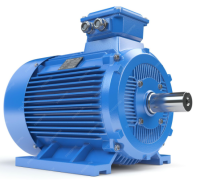
An electric motor is a mechanism that converts electrical energy into mechanical energy, usually by employing electromagnetic phenomena. It achieves this by generating a magnetic field through an electric current passing through wire coils, which creates torque on the motor shaft. Basically it's a machine that takes electricity and turns it into movement. Electric motors can be powered by direct current (DC) sources like batteries or rectifiers, or by alternating current (AC) sources. Standard electric motors are prevalent in industrial applications, finding utility in equipment like blowers, pumps, industrial fans, machine tools, power tools, household appliances, disk drives, and vehicles. But in specific applications such as in traction motors, electric motors can act as generators to reclaim energy otherwise dissipated as heat and friction.
TYPES OF MOTORS
Basically Electric motors are classified into AC motors, DC motors and Special purpose motors. AC motors use alternating current, DC motors use direct current, and special purpose motors are designed for specific applications.
Based on Power Supply -
1. AC MOTORS (Alternating Current) :-
AC motors also known as alternating current motors that convert an alternating voltage as the main input power into mechanical power in the form of rotational movement. Like all electrical machines, AC motors fundamentally consist of a fixed stator and a moving rotor which is a rotating part. The windings arranged in both the stator and on the rotor shaft to create a constant electromagnetic field of rotation when alternating voltage is added, which causes the rotor to rotate the motor shaft.
Types of AC Motors :
Induction Motors :
What is an Induction Motor ?
An Induction motor is an AC electric motor that operates on the principle of electro-magnetic induction. Induction motors are the most common type of AC motor used in industries, also known as asynchronous motors. In induction motor the rotor speed is always slightly less than the synchronous speed of the stator’s rotating magnetic field.
Types of Induction Motors :
Based on the rotor type and the number of phases, there are the following types of induction motor.
Based on Rotor type -
i) Squirrel Cage Induction Motor ii) Wound Rotor or Slip Ring Induction Motor
Working Principle of Squirrel Cage Induction Motor :
Actually, when we give AC power supply to the stator winding, the current flow in the coil will produce a magnetic flux in the coil. Now, set the rotor windings to short circuit. The flux from the stator will cut the coils in the rotor and according to the Faraday’s law of electromagnetic induction will cause the current to flow in the coil of the rotor due to the short circuit of the rotor coil. The stator and rotor current flow produces two fluxes, one is the stator flux and the other is the rotor flux, and the rotor flux will lag behind the stator flux. Thus, the rotor will feel the torque that rotates the rotor in the direction of the rotating magnetic flux. Therefore, the speed of the rotor will depend on the AC power, and the speed can be controlled by changing the input power supply.
Advantages of Squirrel Cage Induction Motor :
Squirrel Cage Induction Motors (workhorses of industry) have several big advantages that explain why they’re everywhere from fans to pumps to conveyor belts. These motors are simple, robust and economical, though they limitations in speed control and starting current. It has high efficiency and Power Factor at Full Load and near Full Load condition.
1. Rugged and Durable : There are no brushes, commutators or delicate winding on the Rotors. They can run for decades with minimal issues.
2. Low maintenance : As per their simple design, they need little more than occasional lubrication of bearings.
3. Cost Effective : Easy to manufacture, relatively cheap comparatively to others and they're widely available.
4. High Efficiency : It works with minimal losses, especially in larger sizes.
5. Reliable starting : They can start under load without needing any fancy external equipment.
6. Robust against environmental factors : Many designs are dustproof, explosion-proof or water-resistant. They're good for tough industrial usage and also for longevity.
7. Wide speed range with modern Drives : Their speed can be controlled finely and frequently without any hustle with Variable Frequency Drives (VFDs).
8. Compact Size : They are designed as High power-to-weight ratio.
9. Safety : They have no sparking parts (like brushes), safer in explosive or flammable environments.
10. Global availability : They're widely available, standardized, easily replaceable and supported worldwide.
Disadvantages of Induction Motors :
While Induction motors are widely used due to their numerous advantages, they also come with some certain disadvantages. Here are the notable disadvantages of induction motors:
1. Starting Torque Limitation : Induction motors, especially squirrel cage types, often have lower starting torque compared to others. This can make them unsuitable without additional starting mechanisms like capacitors or special starters for devices which requiring high starting torque like cranes or heavy machinery.
2. High Inrush or Starting Current : Induction motors are typically draw a high inrush current when starting, which can be several times their full-load current and its more. This can be cause voltage drops in the power system and necessitate the use of special starting methods (e.g., star-delta starters, soft starters) to reduce the impact.
3. Poor Speed Control : Compared to DC motors, speed control of induction motors is less straight forward. While devices like Variable Frequency Drives (VFDs) exist and it add complexity and costly. Simple speed control methods like voltage variation are inefficient and not very effective, especially for precision applications.
4. Dependence on Slip : The speed of an induction motor depends on the slip, which is the difference between the synchronous speed of the magnetic field and the actual rotor speed. This dependence on slip means that the motor's speed can't be precisely controlled and varies with the load. Under varying load conditions, maintaining a consistent speed can be challenging without advanced control systems.
5. Lower Power Factor : Often Induction motors operate at a lower power factor, particularly at partial loads. A lower power factor results in higher apparent power consumption, which can increase the demand charges on an electrical system. Power factor correction devices may be required to compensate for this, adding to the overall system cost and sometimes it's necessary.
Usage of Induction Motor :
Induction motors are widely used in many industries including pumps, fans, compressors, conveyors, cranes, and elevators. The choice of motor depends on load, speed and conditions.
What is Wound Rotor or Slip Ring Induction Motor ?Slip Ring or Wound Rotor Induction motor has a rotor winding similar to the stator winding and is connected to external resistors or controllers via slip rings. This allows for better control of starting torque and speed, making it suitable for applications requiring variable speed and high starting torque. But, it is more expensive and requires more maintenance. This type motor is referred to as an asynchronous motor as the speed at which it operates is not equal to the synchronous speed of a rotor. The rotor of this type of motor is wound type. It comprises of a cylindrical laminated steel core and a semi-closed groove at the outer boundary to accommodate a 3-phase insulated winding circuit.
Working Principle of Slip Ring or Wound Rotor Induction Motor :
This motor runs on the principle of Faraday’s law of electromagnetic induction. When a stator winding is excited with an AC supply, the stator winding produces magnetic flux. Based on faraday’s law of electromagnetic induction, the rotor winding gets induced and generates a current of magnetic flux. This induced EMF develops torque that enables the rotor to rotate. However, the phase difference between the voltage and current do not meet the requirements to generate high starting torque as torque developed is not unidirectional. The external resistance of high value is connected with the circuit to improve the phase difference of a motor. As a result, inductive reactance and phase difference between current and voltage is reduced. Consequently, this reduction helps the motor to generate high starting torque.
Advantages of Slip Ring Induction Motor :
1. Low Maintenance : This type of motor does not require frequent maintenance, as it is designed to be durable and reliable. This makes it a great choice for applications where frequent maintenance is not feasible.
2. Easy to Install : Slip Ring motor does not require complex wiring or complicated installation procedures. This makes it a great choice for applications where installation needs to be done quickly and easily.
3. High Efficiency : Slip Ring motor is able to convert more of the electrical energy into mechanical energy, resulting in less energy being wasted. This makes the motor more efficient and cost-effective in the long run.
4. High Torque Output : Finally, slip ring induction motor is able to produce high torque output for applications that require high torque output, such as pumps and compressors and used in many industrial and commercial applications.
Disadvantages of Slip Ring Induction Motor :
1. Efficiency Losses : Extra resistance in the rotor circuit increases power loss, lower efficiency compared to squirrel cage motors.
2. Higher Cost : Slip Ring Motors are more expensive than squirrel cage induction motors because of slip rings, brushes, and the external resistance system.
3. Maintenance Issues : Brushes and slip rings wear out due to friction, that's why frequent maintenance and replacement needed.
4. Sparking Problem : Brushes can spark, which is dangerous in explosive or dusty environments.
5. Bulkier Design : Slip Ring Motors are larger and heavier due to additional components.
6. Speed Range Limitation : Though speed control is possible, it’s not very efficient, lot of energy is wasted as heat in the external resistances.
7. Noise & Vibration : They are noisier compared to cage motors due to brush contact and external connections.